Introduction
The raw syngas produced in the gasification process contains impurities or undesirable components like particulates, tar, sulfur compounds for example, making it unsuitable for a wide range of downstream applications. These contaminants would plug pipelines & filters, corrode equipment, poison catalysts and damage sensitive downstream equipment, thereby increasing the maintenance costs. This necessitates an adequate gas conditioning system to tailor the gas for the final gas utilization or downstream applications, such as power generation, direct thermal applications, fuel synthesis, etc.
AHT extends its core competence by delivering conditioned syngas through an integrated suite of gas-conditioning technologies, making the gas suitable for downstream applications such as combined heat and power (CHP) systems and thermal (hot gas) processes. This product portfolio comprises of (1) Dry Gas Conditioning, as well as (2) Wet Gas Conditioning technologies. In Dry Gas Conditioning, the syngas temperature is maintained above the dew point of tar and water to prevent condensation while removing contaminants.
Wet Gas Conditioning includes additional cleaning stages in which the syngas is cooled below the dew point and contacted with water, allowing for the removal of condensable and water-soluble contaminants to produce a higher-purity syngas. Following this, our Gas Conditioning systems are labelled as “EcoFilter-Dry/Wet”, depending on which Gas Conditioning process it is in. The description and benefits of our Gas Conditioning product lines are given in the subsequent sections.
The Gas Conditioning stage from AHT ensures:
• Diversified end applications of the syngas produced, by meeting stringent purity requirements
• Protection of equipment for optimization of process performance and reduction of maintenance costs.
• Efficient heat recovery from viable sources, minimizing energy losses and increasing overall efficiency
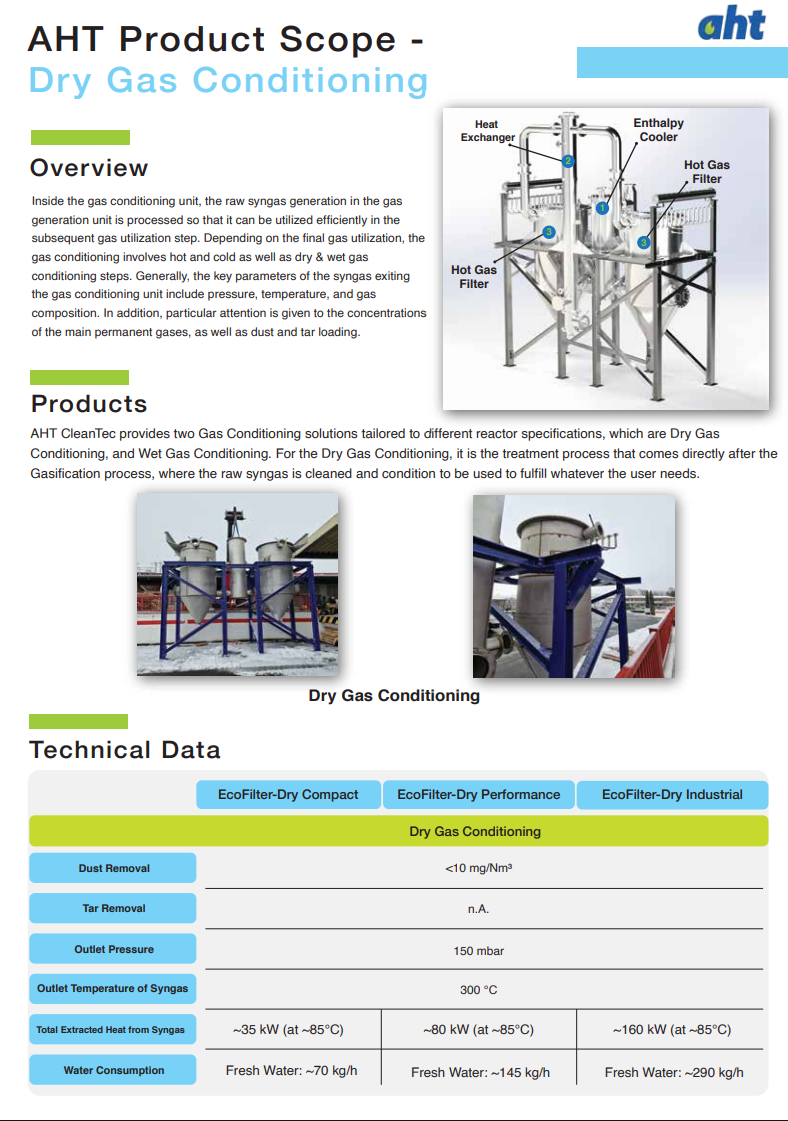
The dry gas conditioning stage performs rudimentary gas cleaning after syngas generation, focusing on the removal of coarse contaminants and the stabilization of gas conditions to render it useful for robust downstream applications. As part of the dry gas conditioning stage, the high-temperature raw syngas from the gasifier initially enters the Enthalpy Cooler, where it is cooled using the enthalpy of water vaporization, reducing the temperature to approximately 500°C for safe downstream handling.
The cooled syngas is then ready for dust filtration, and it passes through the Hot Gas Filters where the solid particulate matter larger than 2 µm is captured on filter candles. This step ensures a clean and dust deprived syngas, preventing it from contaminating the downstream equipment. The subsequent step involves the recovery of thermal energy from the syngas using a Hot Gas Heat Exchanger where the recovered heat may be reused to meet the needs of the client.
Moreover, the syngas is cooled to conditions suitable for downstream conveying/compression by the Hot Gas Blower. The hot gas blower delivers the hot syngas at temperatures of 250-350 °C and pressures of up to 150 mbar to the point of application as a final conditioning step.
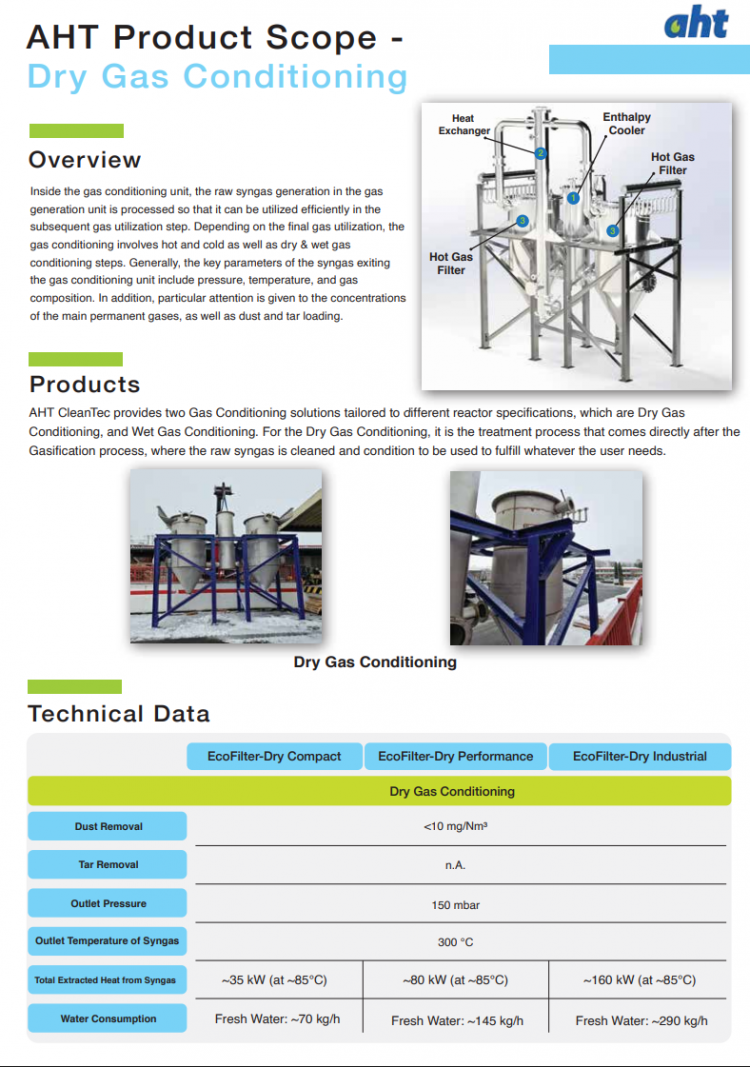
For additional technical data regarding our Dry Gas Conditioning product category, all relevant information on the AHT product line Dry Gas Conditioning can be found in the brochure below.
Benefits | Effect |
|---|---|
| By focusing on the essential gas cleaning and conditioning steps, the process delivers a practical and cost-efficient solution with reduced system complexity, lower operating costs, and reliable performance |
| Heat removed from the syngas inside the gas conditioning unit can be used efficiently for other processes (e.g. drying, space heating, or steam generation), thereby improving overall system efficiency. |
| The gas conditioning system accommodates variations in syngas production, ensuring stable and efficient gas cleaning over a wide operating range. This enables seamless integration with changing process conditions while maintaining consistent gas quality. |
| The process is designed in such a way that the syngas temperature never falls below the tar dew point, thus preventing tar condensation and related problems (e.g. fouling, clogging). |
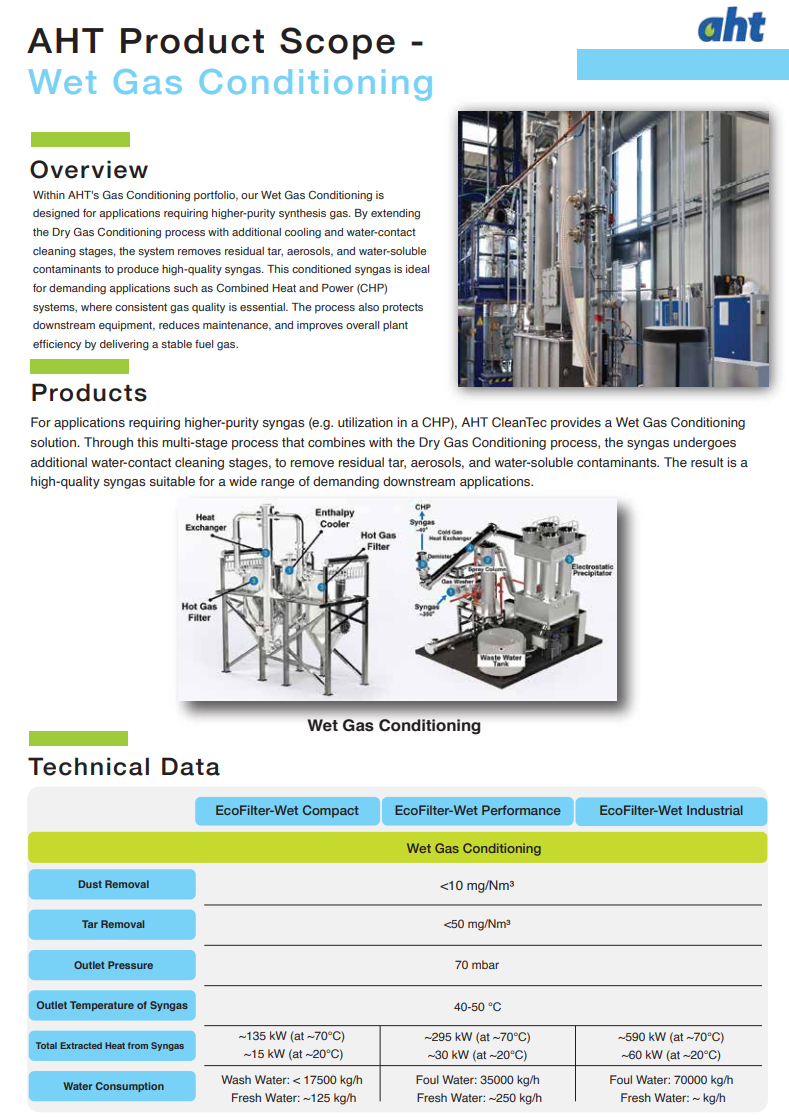
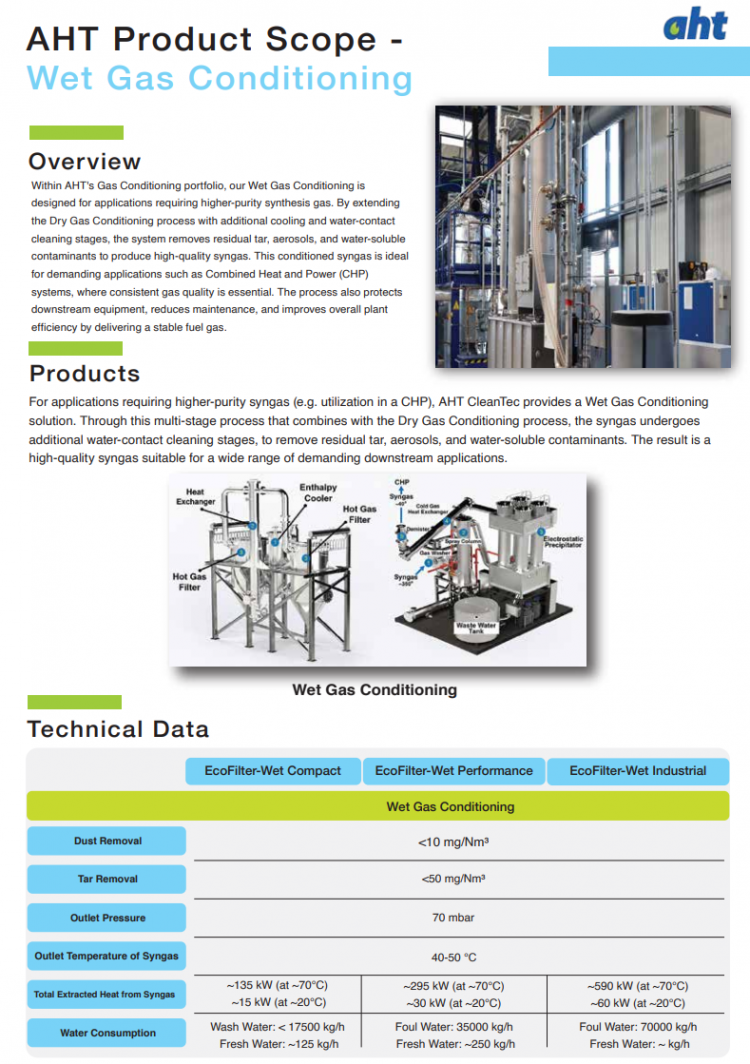
Intricate downstream applications require advanced gas cleaning techniques tailored to their specific requirements. In such cases, an additional gas conditioning step, beyond primary cooling and particulate removal, is necessary to eliminate residual contaminants such as tars, aerosols, and other water-soluble inorganic contaminants. The wet gas conditioning is a multi-stage process combining dry gas conditioning along with additional water contact stages to provide syngas of high quality as the product.
The high-temperature raw syngas from the gasifier initially enters the Enthalpy Cooler, where it is cooled using the enthalpy of water vaporization, reducing the temperature to approximately 500°C for safe downstream handling. The cooled syngas is then ready for dust filtration, and it passes through the Hot Gas Filters where the solid particulate matter larger than 2 µm is captured on filter candles. This step ensures a clean and dust deprived syngas, preventing it from contaminating the downstream equipment.
The subsequent step involves the recovery of thermal energy from the syngas using a Hot Gas Heat Exchanger where the recovered heat may be reused to meet the needs of the client. Within the HG-HEX, the syngas is cooled below its dew point (~65°), entailing the condensation of moisture and tars. The gas is then fed into a Scrubber unit, where a finely dispersed gas–water mixture is formed, and the gas pressure is increased. This mixture thereafter passes through the Spray Column in which the gas flows through a packed bed while encountering a counter-current water spray.
This ensures effective capture of fine particulate matter and the removal of water-soluble contaminants (e.g., HCl, NH₃). The aerosols generated in the previous stages are removed from the gas stream in the downstream Electrostatic Precipitator under induced electrostatic force.
Subsequently, the aerosol free gas stream is then led to a Cold Gas Heat Exchanger, where further cooling to a temperature of 25°C removes the moisture content by condensation and prepares the gas for downstream use and compression. The cleaned gas subsequently travels through a Demister where remaining water mist is removed before it is compressed to its application pressure (~50 mbar) by the Gas blower. Shown below is a diagram of our Wet Gas Conditioning in its entirety
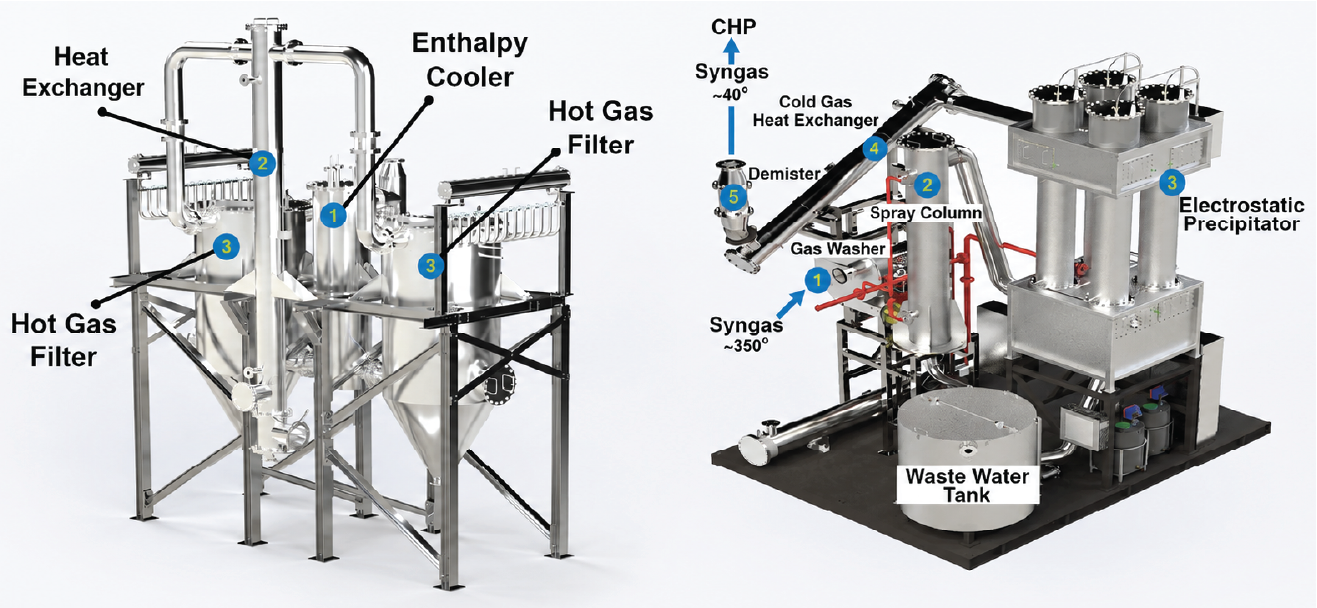
For additional technical data regarding our Wet Gas Conditioning product category, all relevant information on the AHT product line Wet Gas Conditioning can be found in the brochure below.
Benefits | Effects |
|---|---|
| Through our wet gas conditioning process, dust, tar, contaminants, and aerosols are effectively removed, reducing wear on downstream components, extending cleaning intervals, and thereby lowering the overall operating costs of the gas utilization equipment. Due to its high purity the conditioned syngas is suitable for a wide range of applications (e.g., heat and power generation in CHP units). |
| Heat removed from the syngas inside the gas conditioning unit can be used efficiently for other processes (e.g., drying, space heating, or steam generation), thereby improving overall system efficiency. |
| The gas conditioning system accommodates variations in syngas production, ensuring stable and efficient gas cleaning over a wide operating range. This enables seamless integration with changing process conditions while maintaining consistent gas quality. |
| Wet gas conditioning removes potentially problematic contaminants from the syngas stream, helping to ensure that emission limits in downstream utilization processes are reliably met. By reducing dust, tar, aerosols, and water-soluble contaminants, it supports stable and compliant operation of subsequent gas utilization steps, lowers the risk of exceeding regulatory thresholds, and improves environmental compatibility of the overall system. |
AHT Core Competence: Conditioning the Synthesis Gas
If a very high gas purity is required, the generated synthesis gas undergoes a combined wet gas scrubbing and cooling in the gas conditioning. In the last cleaning step, the remaining interfering aerosols are removed in a downstream, specially developed wet Electrostatic precipitator (ESP).
This offers the possibility of using the cleaned gas in ovens and combined heat and power plants.