Introduction
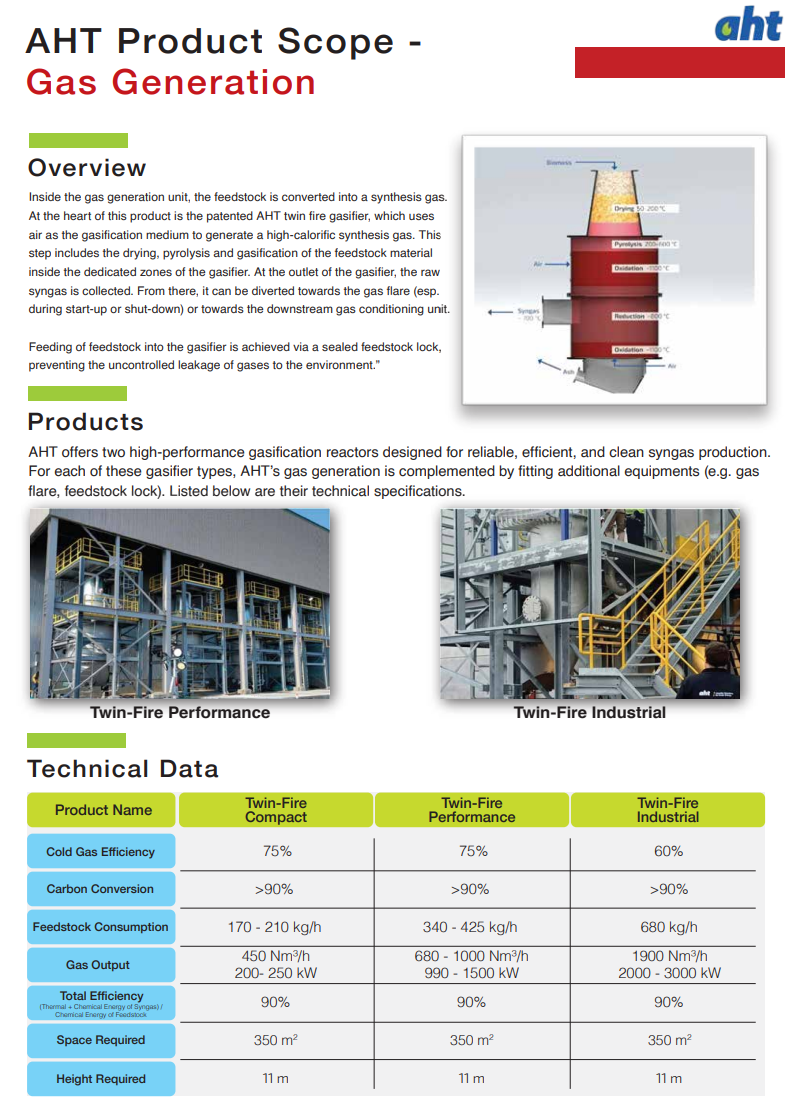
In the Gas Generation product category, one of the core competences of AHT is situated – converting solid feedstocks into a valuable, high-calorific synthesis gas. Generating gas from renewable (waste-derived) solid feedstock signifies an ideal solution for independent and decentralized energy production, enabling businesses to secure a reliable supply of heat and power, while reducing their dependence on fossil fuels. Through our reactor that we label as “Twin-Fire”, the description and benefits of our Twin-Fire Gasification product line is given below.
Here, a combination of updraft and downdraft gasification is used to efficiently convert solid feedstocks into a synthesis gas. If you have access to biogenic residues, we are happy to test their suitability for gas generation, in order for you to enjoy the advantages of self-sufficient, decentralized, and CO₂-neutral energy generation.
We believe that Gas Generation is a cornerstone in the energy transition, as converting solid feedstocks into a valuable syngas means that:
• A wide array of solid feedstocks can be converted into a valuable synthesis gas
• The produced syngas can be used efficiently for a wide array of energy applications
The patented AHT “Twin-Fire“ gasifier combines updraft and downdraft gasification, resulting in the efficient generation of a raw synthesis gas from a variety of different feedstocks.
Here, the feedstock is fed to the gas generator from above. Feeding is automatic and controlled by the level of the input material in the conical part of the gas generator. In the upper regions of the gasifier, the feedstock is then dried and pyrolyzed.
Gasification reactions in the downdraft section of the gasifier are initiated via the controlled addition of air, functioning as an oxidation medium, above the syngas outlet. This addition of air into the gasifier results in a conversion of hydrocarbon compounds of the feedstock into combustible synthesis gas, mainly consisting of CO and H₂.
The formed synthesis gas then leaves the reactor through the middle section, where it is sucked out by negative pressure. Below the gas outlet, the remaining feedstock travels through the updraft section of the gasifier towards the ash grate. Here, additional air is added, leading to a close to complete conversion of the feedstock in the lower gasifier section thereby generating more synthesis gas, which also leaves the gasifier through the middle section.
The resulting residual ash is automatically discharged through an ash grate and a conveyor screw in the lower gasifier area and are fed to the subsequent process steps. The overall process is schematically illustrated in the Figure below, and is visualized in the video section after.
The produced synthesis gas can be used for a variety of end-use cases, ranging from CHP applications to direct injections into burners for heat or steam provision. Apart from this, further profitable utilization of the resulting ash can also be targeted on a case-by-case basis.
For additional technical data regarding our Gas Generation product category, all relevant information and related products can be found in the brochure below:
Benefits | Effects |
|---|---|
| Our technology enables a close to complete conversion of the feedstock within the gasifier, with only a negligible fraction of the usable energy being retrieved in the gasifier ash. Depending on the use-case of the ash, the energy content of it can be tailored on request. |
| Through a combination of updraft and downdraft gasification within the Twin-Fire gasifier, a syngas that is low in tar and ash is produced. |
| The Twin-Fire gasifier exhibits excellent slagging behavior, requiring less stringent feedstock conditioning and allowing a wider range of materials to be used efficiently. |
| The syngas production rate of the Twin-Fire gasifier can be tailored to client needs. Here, temporary part load operation down to 30% is permissible, yielding excellent process flexibility. |
From Biomass to Syngas
The AHT Twin-Fire reactor operates with the advantages of updraft and downdraft gas production in two oxidation zones!