Introduction
In order to generate clean CO₂-neutral energy using our patented AHT technology, continuous and reliable supply of a suitable feedstock is required. This is where our Feedstock Treatment product category comes into play. Using our know-how, we are able to turn residual materials like sawdust or manure, into valuable feedstock for our gasifiers through different treatment processes.
To achieve this, AHT offers two different product lines: (1) Dry Feedstock Treatment allows the treatment of various dry materials, such as sawdust or woodchips for subsequent gasification and (2) Hydrothermal Carbonization enables the preparation of liquid matter, such as manure or sewage sludge into a feedstock. The description and benefits of both product lines are given below.
Aside from these two product lines, AHT can also take over the preparation and/or procurement of the required feedstock for our clients, thus ensuring a steady supply of feedstock for reliable CO₂-neutral energy generation.
We believe that feedstock treatment can unlock untapped potential in the energy transition, as utilizing biogenic residual and waste materials in the region or directly on site, means that:
• Transport routes are minimized, thus relieving the environment
• Valuable materials can be recovered and re-utilized on site or marketed independently
• Dependence on external energy supplies is decreased or in the best case overcome
• Costs and efforts for waste removal are minimized
Oftentimes, readily available residual materials are missing only simple and straightforward processes in order to transform them into a valuable feedstock, turning a seemingly undesirable material into a valuable resource.
By converting residues into a valuable feedstock for CO₂-neutral energy generation, the AHT Dry Feedstock Treatment product line enables our clients to not only reduce Scope 1 (direct emissions), but also Scope 3 (Value Chain Emissions).
We support our clients in the transition to cost-efficient and fossil-free energy use and raw material supply. If carbon-containing residual materials arise in your value chain or such materials are available in your local surroundings, we are happy to examine the possibilities for use together with you.
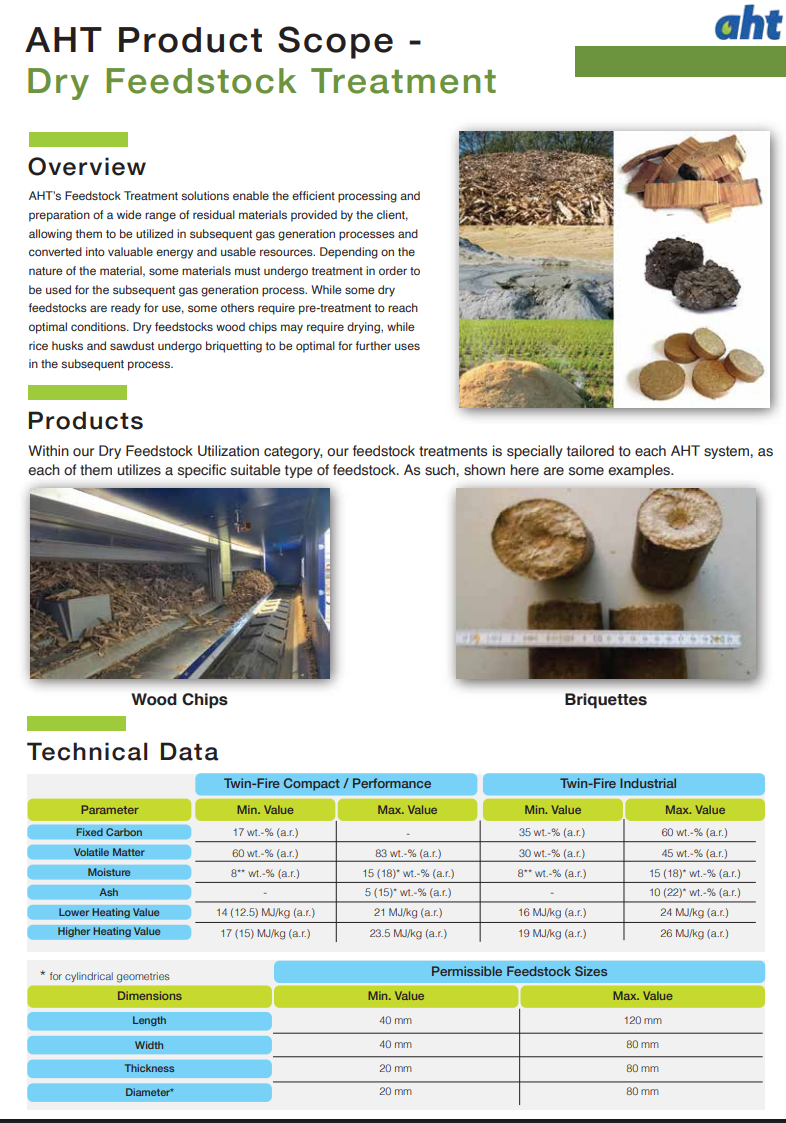
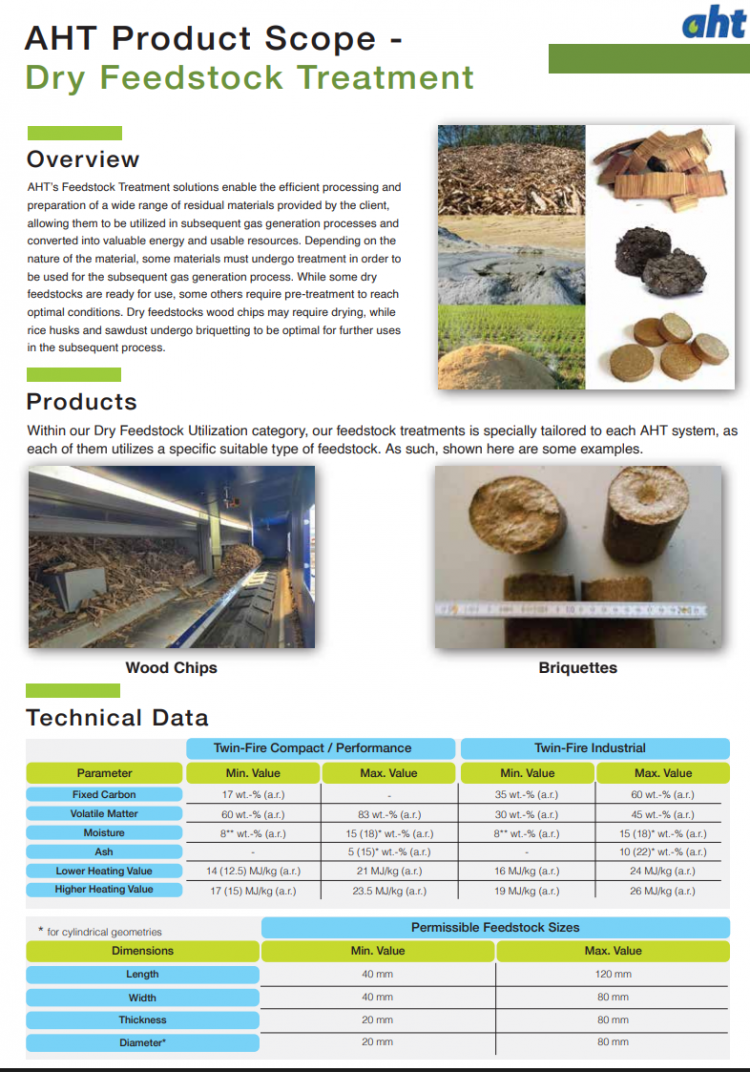
A wide range of (residual) materials from agriculture and food production (e.g. rice husks) or industrial manufacturing (e.g. waste wood or sawdust) are generally suitable for further use, thus signifying an untapped potential. Depending on the nature of the material, processes like drying, shredding, or briquetting can be employed.
Using our know-how and standardized solutions, we will configure a suitable Dry Feedstock Treatment product for you, ensuring an efficient treatment of your material for reliable feedstock supply.
For additional technical data regarding our Dry Feedstock Treatment process, all relevant information on the AHT product line Dry Feedstock Treatment can be found in the brochures below.
Benefits | Effects |
|---|---|
| Pre-treatment technologies such as shredding, drying, and briquetting enable the processing of a wide range of residual materials, allowing for efficient conversion into valuable feedstocks. |
| The downstream processes in our CO₂-neutral energy generation chain produces heat which can be efficiently utilized for feedstock pre-treatment. This ensures high overall efficiency and integration of our systems and thus, significantly reduces OPEX. |
| Through using biogenic residual and waste materials that are found within the local surroundings or directly on-site, transport costs are minimized due to short transport routes |
| Our approach allows local communities & companies to produce their own clean energy from on-site materials. This reduces dependance on the power grid and/or external fuel supply, and helps in securing self-sufficient fossil-free energy generation. Furthermore this also reduces waste removal costs, and associated potential value chain emissions. |
Through hydrothermal carbonization (HTC), liquid and pasty materials can be efficiently processed for nutrient recovery and fuel production.
To give meaningful use to sludge or other liquid starting materials, they must first be mechanically dewatered and then thermally dried. With conventional methods, this process is very energy-intensive and thus costly.
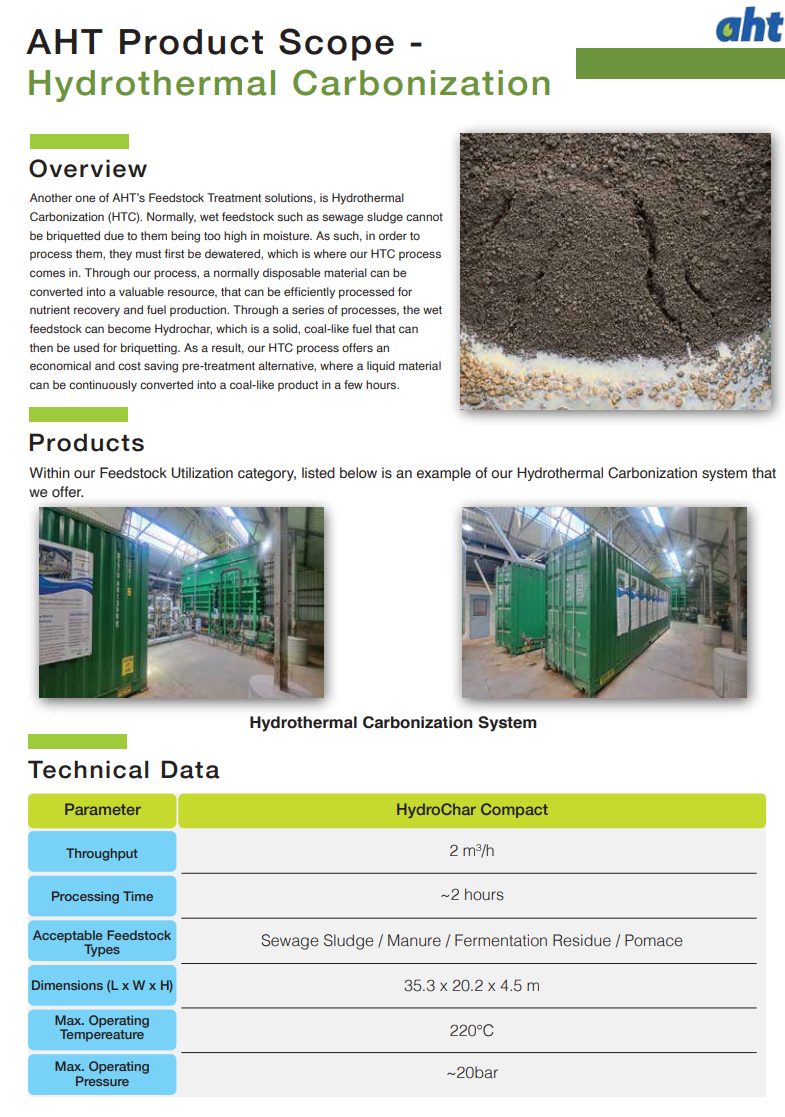
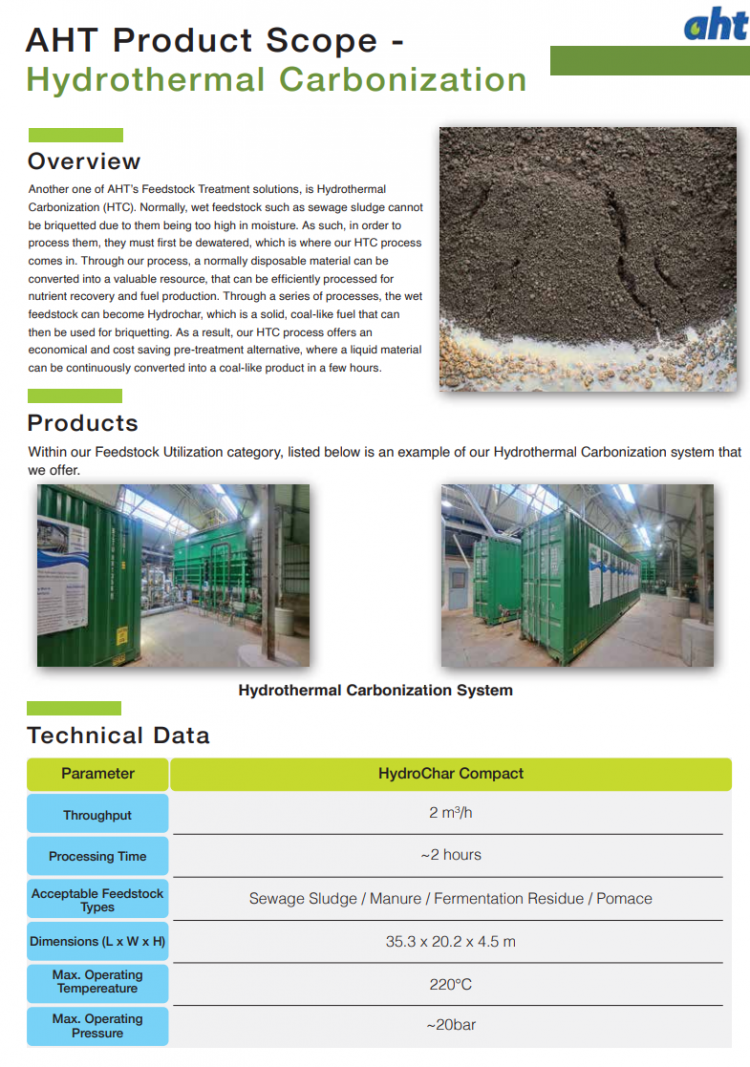
The HTC process imitates the natural formation of hydrochar. With state-of-the-art HTC technology, AHT can convert wet biomass residues such as sewage sludge, manure, fermentation residue, seaweed, or pomace effectively into so-called hydrochar within a few hours.
During this process, valuable substances such as phosphorus and nitrogen are dissolved in the aqueous phase, from where they can subsequently be separated efficiently, which signifies another major advantage of the HTC process, when aiming at the closing of important material cycles.
Therefore, hydrothermal carbonization opens the alternative of efficient and economic utilization of liquid waste streams for energy generation, as a coal-like feedstock is produced within a few hours without relying on energy- and cost-intensive pre-treatment steps.
For additional technical data regarding our Wet Feedstock Treatment process, all relevant information on the AHT product line Hydrothermal Carbonization can be found in the brochures below.
Benefits | Effects |
|---|---|
| Unlike other HTC approaches which rely on a batch process, our approach focuses on continuity. As such, our approach has lower downtime compared to other approaches, thus enabling higher throughput. Furthermore, it allows for an integrated heat recovery, yielding, and higher overall efficiency compared to other HTC technologies. |
| Through our HTC process, wet feedstocks that tend to necessitate extra cost for disposal (e.g. sewage sludge), can instead be treated as a valuable resource which can generate revenue for municipalities & companies. |
| The HTC technology facilitates an efficient recovery of important material streams (e.g. phosphorus), from the liquid materials entering the process. This is related to the fact that these substances accumulate in the aqueous side product origination from the HTC process, from where they can be separated efficiently for further use. |
| The HTC technology allows local communities & companies to produce their own clean energy from on-site materials. This reduces dependance on the power grid and/or external fuel supply, and helps in securing self-sufficient fossil-free energy generation. Furthermore this also reduces waste removal costs, and associated potential value chain emissions. |