Introduction
Featuring our Gas Utilization product category, efficient utilization of the generated and conditioned syngas is crucial to attain high overall process efficiencies and thus, decent plant profitability. Depending on the final use, this gas utilization can have different shapes and forms.
At AHT we are focusing on three main product lines: (1) Heat & power generation by syngas combustion in a combined heat & power unit (CHP), (2) Combustion in dedicated syngas burners for high temperature heat provision, and (3) Separation and purification of hydrogen (H₂) for usage in hydrogen applications or storage. The description and benefits of our Gas Utilization product lines are given below.
Efficient Gas Utilization is a must-have for any process chain relying on the production and utilization of synthesis gas. We are convinced that the efficient utilization of conditioned syngas means that:
• A wide array of processes relying on fossil fuels (e.g. natural gas) can be made CO₂-neutral
• Stringent emission guidelines can be met
• A continuous base-load behavior can be attained
One use–case of our conditioned syngas is through funneling it into a combined heat & power plant (CHP). Here, the syngas is used to generate electricity and heat according to the demands of our clients.
The production of heat and power in a CHP relies on a combustion of the synthesis gas, which drives the engine, generating mechanical energy that is converted into electricity via a generator. Simultaneously, heat from the engine and exhaust gases is recovered through heat exchangers, allowing the system to efficiently produce both electricity and useful thermal energy for a wide range of industrial applications.
Depending on the application, two types of CHPs can be used to ensure reliable ignition and thus combustion of the synthesis gas after mixing it with combustion air in the desired ratio:
- In a CHP unit with pilot fuel a small amount of pilot fuel is injected into the engine’s combustion chamber filled with the air-syngas mixture. Here, it ignites under compression, initiating the combustion process.
- In a CHP unit without pilot fuel, the syngas-air mixture is ignited directly using a spark ignition system, eliminating the need for any auxiliary fuel.
For additional technical data regarding our Gas Utilization process, all relevant information on the AHT product line Combined Heat & Power can be found in the brochures below.
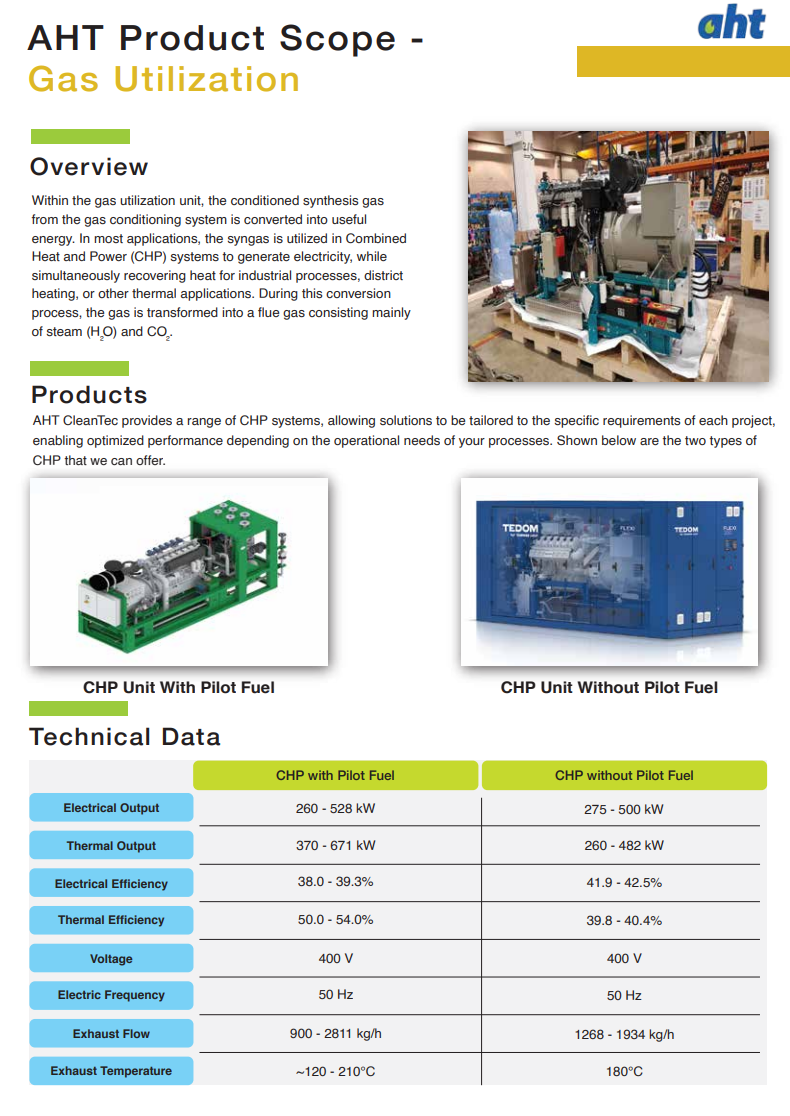
Benefits | Effect |
|---|---|
| The CO₂-neutral heat and electricity from the CHP units can be used for a variety of applications, such as district heating, industrial processes, and more depending on our clients’ needs. |
| The CHP is excellent for covering base-load requirements for year-round applications, requiring uninterrupted heat and/or power supply. Further, the heat & power output of the CHP can be tailored to the actual heat and power demand, making it an excellent building block in current-day volatile energy markets. |
| As our CHP units achieve an electrical efficiency of over 40%, this high efficiency reduces overall operating costs by lowering feedstock consumption, thus making your energy production more cost effective. |
| As our CHP units produce CO₂–neutral electricity through efficient utilization of “green” synthesis gas, the overall carbon footprint of any operation can be lowered, thus allowing compliance with environmental regulations. |
Another highly relevant use-case for syngas is its utilization in burner applications for direct high-temperature heat applications (e.g. cement production, clay and fireclay production, lime manufacturing, & food industry).
In such applications, hot or conditioned synthesis gas is directly transferred to the dedicated burner site. Here, it is mixed with air in the desired ratio and ignited, leading to a stable flame. With this approach, processes requiring temperatures up to 1200°C can be supplied with a CO₂-neutral energy source, which is independent of global energy supply chains.
Using our know-how with syngas applications, we can support our clients in retro-fitting or adapting burners for syngas utilization. Alternatively, we can supply complete burner units, making use of our partner network.
Benefits | Effects |
|---|---|
| The CO₂–neutral high temperature heat produced from syngas can be used for a variety of applications, such as cement production, clay and fireclay production, lime manufacturing, or in the food industry, and more depending on our clients’ needs, making it an ideal replacement for almost any process still relying on fossil fuels. |
| Dedicated syngas burners are excellent for covering base-load requirements for year-round applications, requiring uninterrupted heat supply. Further, the heat provision by the burner can be tailored to the actual heat demand, to ensure high efficiency of the overall process chain. |
| By directly injecting hot synthesis gas into the syngas burner, cleaning requirements for the syngas are reduced significantly, e.g. by eliminating tar-related fouling issues. Further, the sensible heat contained in the synthesis gas can be used directly where it is needed, increasing efficiency. |
| Combustion of our “green” synthesis gas produces CO₂–neutral high temperature heat, thus reducing the overall carbon footprint for applications where electrification is not easily viable. Thereby, the overall carbon footprint of operations employing high temperature processes can be lowered, thus allowing compliance with environmental regulations. |
Looking at future decarbonization of entire industries, the reliable and environmentally compatible production of green hydrogen becomes an important challenge.
AHT is working on different avenues to produce H₂ from synthesis gas, using processes ranging from innovative H₂ separation from nitrogen containing synthesis gas to more established process configurations, where H₂ is produced from a N₂-free syngas.
Depending on the requirements of our clients, e.g. in terms of hydrogen purity and quantity, we can develop test and pilot plants for continuous green H₂ production.
Benefits | Effects |
|---|---|
| Green hydrogen is a sought-after commodity which can be used in a wide range of applications, ranging from heating, over mobility to the chemical industry. Reliable production of H₂ thus poses an excellent business opportunity due to steady demand and high revenues. |
| The green hydrogen market is a booming segment promising exponential growth rates in the coming years. Establishing know-how in its production ensures a first-mover advantage for municipalities and companies. The European Union targets the production of 20 billion tons of green hydrogen per year, which is one of the reasons why the green hydrogen market is projected to reach a value of € 200 billion by 2034. |
| The combination of biomass gasification, gas conditioning, decentralized energy generation, and industrial gas utilization forms a strong technological foundation. Hydrogen produced from biogenic waste materials can become an important building block for decarbonization, circular processes, and regional value creation in the future. |